
A steel tower rises from the ocean, surrounded by nothing but billowing waves and sky. Beneath it, a drill cuts through layers of rock that have been sealed underground for millions of years. Oil rigs are not just industrial structures; they are some of the most extreme examples of human engineering, designed to operate under intense pressure and unpredictable conditions.
An oil rig is a large structure or vessel used to drill wells, extract crude oil, and harvest natural gas from beneath Earth’s surface. Its purpose is to access and draw up oil and gas from reservoirs, processing it through continuous extraction, playing a critical role in providing global energy and supporting economies. By combining physics, mechanical engineering, and fluid science, oil rigs make it possible to safely reach resources buried deep beneath the earth’s surface [1].
Modern oil drilling began in the mid 1800s when the first successful commercial oil well was drilled by Edwin Drake in Pennsylvania [2]. Since that first well, oil drilling technology has evolved dramatically, transforming simple land based rigs into complex offshore systems capable of operating thousands of feet below the surface. Understanding how these systems work requires examining the major engineering components that allow drilling to occur safely and efficiently.
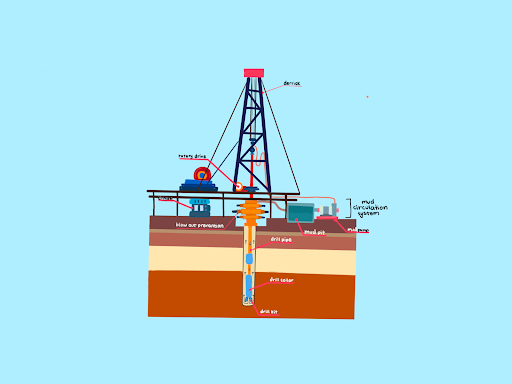
The most recognizable part of an oil rig is the derrick, the tall steel tower above the drilling platform. While it may appear to be the drilling mechanism itself, the derrick’s role is to provide vertical support for the drilling equipment. It acts as a rigid steel frame that holds the weight of thousands of feet of steel while guiding machinery in and out of the well. From an engineering standpoint, the derrick works like a specialized crane, using pulleys, cables, and motors to move extremely heavy loads [3]. Some drill strings can weigh hundreds of tons, so the derrick must be strong enough to withstand both the weight of the pipe and the constant motion caused by the drilling and the ocean waves.
The drill string and drill bit work together as the principal mechanical system that actually creates the well. The drill string is a long column of connected steel pipes that extends from the rig down into the Earth. It physically links the equipment at the surface to the underground oil and gas reservoirs. Its primary purpose is to transmit rotational force downward from the rig to the drill bit. At the very bottom is the drill bit, which cuts through layers of rock to create the well. Drill bits are engineered to withstand intense heat and pressures over thousands of feet, and typically use rotating cutters or industrial diamonds to break rock apart [4,5].
One of the most important scientific systems of an oil rig is the drilling mud circulation system. Drilling mud is a specially designed fluid pumped down through the drill string and back up the well. This system functions as a continuous loop, pumping drilling mud down though the drill string, across the drill bit, and back up the well to the surface. The mud serves several purposes: it cools and lubricates the drill bit, carries broken rock fragments to the surface, and, most importantly, controls pressure inside the well. By applying hydrostatic pressure, the pressure exerted by a fluid at rest due to the force of gravity, increasing proportionally with depth, the mud prevents oil and gas from escaping uncontrollably, which could lead to dangerous blowouts [6].
Similarly, the blowout preventer (BOP) is a crucial safety device installed at the top of the well. Its job is to seal the well if pressure becomes too high. The BOP uses powerful hydraulic systems that can clamp around the drill pipe or in some cases even cut through it entirely to stop the flow of oil and gas [6]. This system is essential for preventing accidents and protecting both workers and the environment.
Offshore oil rigs must remain stable in harsh ocean conditions. Engineers use principles of buoyancy, anchoring, and structural balance to keep rigs steady against waves and wind. For example, floating rigs rely on carefully distributed weight and submerged structures to reduce motion, while anchored systems secure the rig to the seabed. At the same time, onboard power systems – usually diesel engines or gas turbines – generate electricity to run pumps, motors, and control systems. Without the crucial support of continuous power, drilling operations would not be possible [7].
Oil rigs function not as isolated machines but many integrated engineering systems in which each component continuously affects the others. The hoisting system positions the drill string while the rotary system applies controlled force to break the rock, but neither can operate independently. As drilling deepens, the circulating system must immediately adjust to the changes in pressure and temperature, while the well control system remains ready to respond promptly to any unstable conditions. All of these operations depend on the rig's power system, which converts chemical energy from the fuel into electrical and mechanical energy that drives motors, pumps, sensors, and control equipment across the entire system. They’re also constantly monitored, allowing engineers to respond in real time to changing conditions. Through real time data from sensors throughout the rig, engineers monitor pressure, rotation speed, and mud flow, making constant adjustments to keep the system balanced. Their decisions link mechanical design with human judgment to ensure drilling remains efficient with minimal risk. Together, these interconnected parts enable oil rigs to drill safely, efficiently, and reliably in some of the most extreme environments on Earth.